Understanding the Medicare Levy Surcharge (MLS)
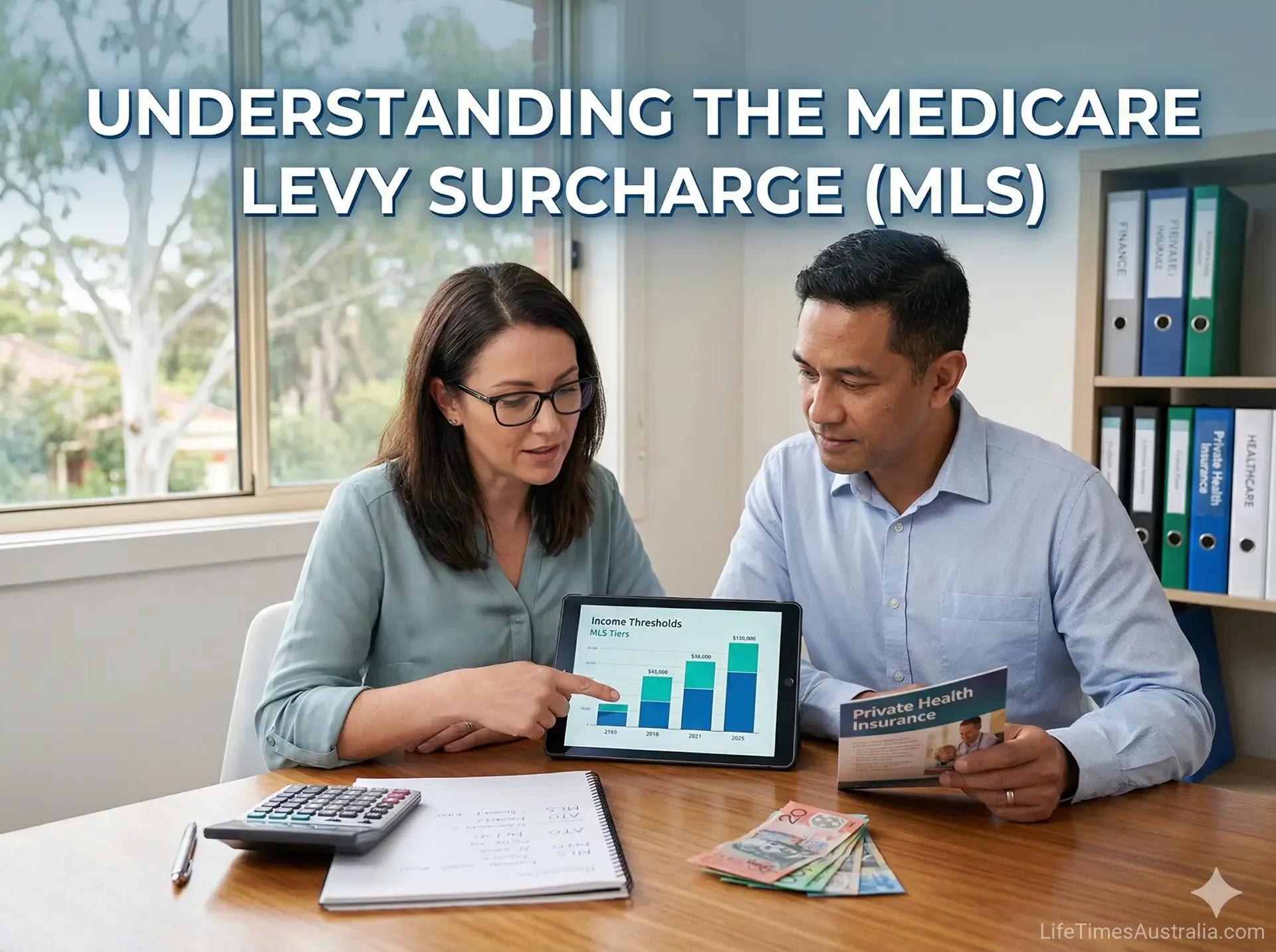
Ever wondered why your tax bill feels heavier than expected, even after paying the standard Medicare Levy? You're not alone—many Aussies get caught out by the Medicare Levy Surcharge (MLS), an extra t...
The Lifetimes Australia editorial team curates, fact-checks, and updates guides on personal finance, property, health, immigration, legal, business, and lifestyle topics relevant to Lifetimes Australia readers. Articles are produced with AI assistance and reviewed by the editorial team before publication.
Ever wondered why your tax bill feels heavier than expected, even after paying the standard Medicare Levy? You're not alone—many Aussies get caught out by the Medicare Levy Surcharge (MLS), an extra tax hit for higher earners without private hospital cover. In 2026, with thresholds sitting at $101,000 for singles and $202,000 for families, understanding the MLS could save you thousands at tax time.
This guide breaks down everything you need to know about the MLS: what it is, who pays it, how it's calculated, and practical steps to avoid it. Whether you're a high earner flying solo or supporting a family, we've got the actionable info tailored for Australian taxpayers.
What is the Medicare Levy Surcharge (MLS)?
The Medicare Levy Surcharge is an additional tax on top of the standard 2% Medicare Levy that most Aussies pay to fund our public health system. It's designed to nudge higher-income earners towards private hospital cover, easing pressure on Medicare hospitals.
Unlike the base Medicare Levy, the MLS only kicks in if your income exceeds specific thresholds and you (plus your spouse and dependents) lack appropriate private patient hospital cover for the full financial year. It's calculated at tax time by the ATO and added to your tax return—no upfront withholding from your pay.
"The surcharge aims to encourage individuals to take out private hospital cover and reduce the demand on the public health system."
Medicare Levy vs Medicare Levy Surcharge: Key Differences
- Medicare Levy: 2% of taxable income for most taxpayers (exemptions for low earners, seniors, etc.). Funds public healthcare universally.
- MLS: Extra 1%–1.5% on your MLS income if you're a high earner without private cover. Targets relief for public system demand.
Bottom line: Everyone chips in via the Levy, but MLS is the penalty for opting out of private insurance when you can afford it.
2026 Income Thresholds and Rates
For the 2025–26 financial year (1 July 2025 to 30 June 2026), MLS thresholds are indexed to Average Weekly Ordinary Time Earnings (AWOTE) and stand at:
| Threshold | Base Tier (0% MLS) | Tier 1 (1% MLS) | Tier 2 (1.25% MLS) | Tier 3 (1.5% MLS) |
|---|---|---|---|---|
| Singles | ≤ $101,000 | $101,001 – $118,000 | $118,001 – $158,000 | ≥ $158,001 |
| Families/Couples* | ≤ $202,000 | $202,001 – $236,000 | $236,001 – $316,000 | ≥ $316,001 |
*Family thresholds increase by $1,500 for each dependent child after the first. Single parents qualify for family tiers.
MLS Income Definition: It's not just taxable income—add reportable fringe benefits, super contributions, net investment losses, and exempt foreign income. Use the ATO's calculator for precision.
Real Aussie Examples
- Single earner on $110,000: Tier 1—pays 1% MLS ($1,100) without cover.
- Couple with one kid on $220,000 combined: Threshold rises to $203,500 ($202,000 + $1,500). Tier 1—1% on $220,000 ($2,200) if uncovered.
- Family of four (two kids) on $250,000: Threshold $206,000 ($202,000 + 2x$1,500). Tier 2—1.25% ($3,125) extra tax.
These examples show how quickly MLS adds up—potentially more than a year's basic private hospital premium.
Who Pays the Medicare Levy Surcharge?
You'll pay MLS if:
- Your MLS income exceeds the base threshold for your situation.
- You, your spouse/partner, and dependents lack appropriate private patient hospital cover all year. (Extras-only policies don't count.)
Dependents include: Spouse/partner, children under 21 (or students to 24), and others per ATO rules. De facto and same-sex couples are treated as families.
Exemptions apply to overseas visitors, certain visa holders, and those with specific cover levels. Check ATO's MLS page for full details.
How is the MLS Calculated?
MLS = Your MLS income × applicable rate (1%–1.5%). It's assessed annually via your tax return.
Step-by-Step:
- Calculate MLS income (taxable income + adjustments).
- Determine tier based on thresholds.
- Apply rate if no cover: e.g., $150,000 single = Tier 2, 1.25% = $1,875 surcharge.
- ATO adds it to your tax bill or reduces refund.
Pro tip: Use the ATO's Private Health Insurance Rebate Calculator—it factors MLS too.
How to Avoid Paying the MLS
The simplest fix? Get private hospital cover before 1 July to cover the full year. Policies must meet ATO 'appropriate level'—covering hospital treatments like joint reconstructions or pregnancy (for families).
Practical Tips for Aussies
- Shop smart: Basic hospital cover from funds like HCF or Bupa often suffices and may qualify for Lifetime Health Cover loading avoidance.
- Timing matters: Cover lapses mid-year? You pay MLS pro-rata. Renew early.
- Family strategy: One policy can cover spouse/kids if income-tested.
- Compare costs: MLS on $120,000 single = $1,200 (1%). Basic cover might cost $1,000–$1,500/year—often a wash or saving.
- Low-cost entry: Bronze/Silver policies hit the mark without gold-plated extras.
Actionable: Head to privatehealth.gov.au for fund comparisons or use ATO tools.
Common Mistakes and How to Dodge Them
- Miscalculating family income—include spouse's earnings!
- Thinking extras cover counts—nope, hospital only.
- Forgetting dependents—kids/students must be covered.
- Ignoring MLS income add-backs like super—bumps you into tiers.
Next Steps to Stay MLS-Free
Don't let the Medicare Levy Surcharge catch you off guard this tax season. Grab your income details, run the ATO calculator, and compare hospital policies today. If you're close to thresholds, a basic policy could neutralise the hit and unlock rebates. For personalised advice, chat with a tax agent or financial adviser—rules can get tricky with investments or self-employment.
Disclaimer: This info is current for 2026 but tax laws change. Always verify with the ATO or a professional for your situation.
Frequently Asked Questions
Sources & References
-
1
A 2026 Guide to the Medicare Levy Surcharge Threshold — www.boxas.com.au
-
2
How the Medicare Levy Surcharge works - HCF — www.hcf.com.au
-
3
Medicare Levy Surcharge - PrivateHealth.gov.au — www.privatehealth.gov.au
-
4
Medicare Levy Surcharge - Private Healthcare Australia (PHA) — privatehealthcareaustralia.org.au
-
5
Medicare Levy vs Medicare Levy Surcharge Explained — bramellepartners.com.au
-
6
Medicare levy surcharge income, thresholds and rates — www.ato.gov.au
-
7
Medicare Levy Surcharge | MLS Calculator - Bupa — www.bupa.com.au
Related Articles

How to Claim the Private Health Insurance Rebate
Ever wondered why your private health insurance premium doesn't hit your wallet as hard as it could? The Private Health Insurance Rebate is the Australian Government's way of chipping in to make quali...
Tax Deductions for Medical Expenses: What Can You Claim?
Ever stared at a stack of medical bills wondering if the ATO might cut you some slack come tax time? You're not alone—many Aussies grapple with healthcare costs, especially as they climb in 2026. Whil...

Bulk Billing Explained: Finding a Free Doctor in Australia
Seeing a doctor shouldn't drain your wallet. Thanks to Australia's Medicare system and recent government reforms, bulk billing has become more accessible than ever before. If you're tired of paying ou...
The NDIS (National Disability Insurance Scheme) for Permanent Residents
Imagine building a life in Australia as a permanent resident, only to face daily challenges from a permanent disability that makes simple tasks like getting dressed or catching a bus feel overwhelming...